- Published on
The History of Live Coding: From Bell Labs to the Algorave
- Authors
- Name
- Nes Croft
- @nescroft
The History of Live Coding: From Bell Labs to the Algorave
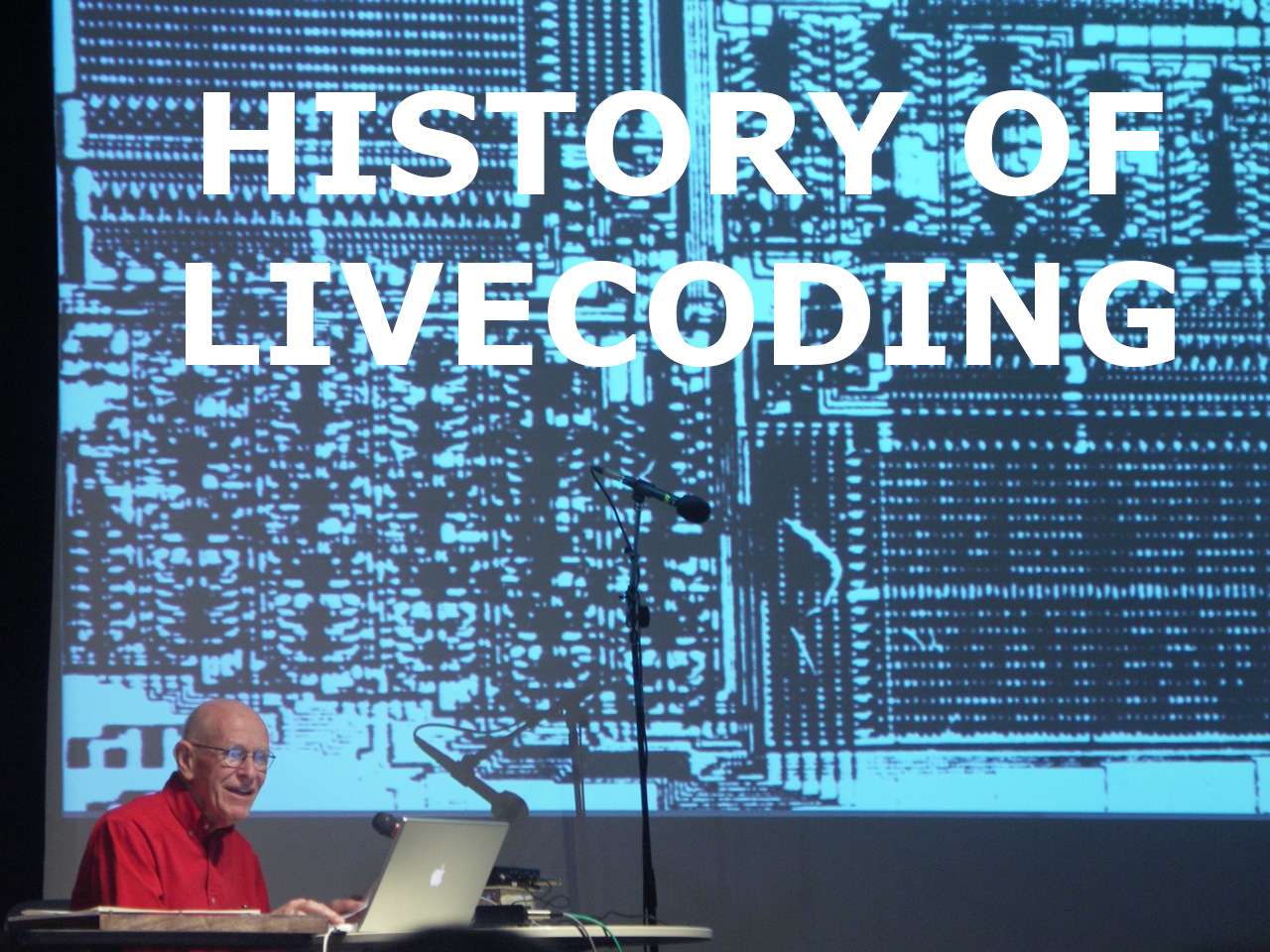 Max Matthews on his 80th birthday
There is something provocative about a performer sitting at a laptop, typing furiously, while music pours out of the speakers. No guitar, no knobs to twist, no DJ decks to spin. Just a person, a keyboard, and code running in real time. Live coding is one of the stranger performance traditions in contemporary music, and it has a history that reaches back much further than most people expect.
The Machine That Learned to Sing
The story starts not in a club, but in a laboratory. In 1957, Lejaren Hiller and Leonard Isaacson at the University of Illinois produced the Illiac Suite, a string quartet composed partly by computer, the first of its kind. A few years later, Max Mathews at Bell Labs wrote MUSIC I, the first software capable of generating audio digitally, and in 1962 published an article in Science that brought the idea of computer music to a wide scientific audience. Mathews became known as the father of computer music, and the language he developed eventually evolved into the family of MUSIC-N tools that informed nearly everything that followed.
Through the 1960s and 1970s, composers like John Chowning and James Tenney pushed digital synthesis further. Chowning discovered FM synthesis, Tenney made noise music with computers at Bell Labs, and a culture of experimental computer music began to take root in universities and research centres. The computers were large, the programming was painstaking, and the results were often more interesting to scientists than to dancers.
Interactive Environments and the Visual Turn
The 1980s brought a shift. Instead of writing programs that generated finished audio, musicians wanted tools they could play with in real time. Miller Puckette at IRCAM in Paris designed a system to let composers build interactive performance setups without writing C code from scratch. That system was licensed in 1990 and became Max, named in honour of Max Mathews. Later, the addition of audio signal processing gave us Max/MSP, a patchwork visual environment that became a standard tool for experimental musicians and sound artists.
Puckette also released Pure Data in 1996, an open-source version of the same ideas, freely available to anyone. Both Max/MSP and Pure Data belong to the tradition of visual programming, connecting boxes with virtual cables rather than writing text. They sit at the edge of live coding but are important ancestors of it.
Around the same time, James McCartney released SuperCollider in 1996. Where Max used visual patches, SuperCollider was a full text-based programming language for real-time audio synthesis. McCartney released it as free software in 2002, and that act of generosity changed everything. SuperCollider became the audio engine and playground for a generation of experimental programmers, and remains foundational to the live coding world today.
TOPLAP and the Read Me
By the early 2000s, scattered musicians in different countries were discovering that writing and running code in front of an audience was both technically exciting and theatrically interesting. The practice needed a name, a community, and a manifesto.
In February 2004, a group of artists and researchers gathered at the Changing Grammars symposium in Hamburg. Late on a Saturday night, in a bar that had seen clearer moments, they formally established TOPLAP, the Temporal Organisation Per Laptop And Plinth, though the acronym has been playfully re-expanded in many directions over the years. The founding group included Alex McLean, Julian Rohrhuber, Nick Collins, and others who had been independently exploring real-time code performance.
TOPLAP published a "Read Me" document, a loose manifesto that articulated what live coding meant to them. Central to it was the idea that code should be visible to the audience. If you are performing with a computer, the screen should be projected. The act of thinking and typing should be part of the show, not hidden behind a sleek interface. "Show us your screens," it said, and that principle stuck.
Languages Built for the Stage
The tools improved rapidly once the community had a home.
ChucK, created by Ge Wang and Perry Cook at Princeton in 2002, introduced the idea of "strongly timed" programming, where time advances explicitly in the code itself, giving performers sample-accurate control over musical timing. It powered the Princeton Laptop Orchestra and became a standard in academic live coding.
Impromptu, built by Andrew Sorensen in the 2000s for Mac OS X, used the Scheme programming language and was designed specifically for live audiovisual performance. Its successor, Extempore, pushed that work further and brought it to more platforms.
Fluxus, developed by Dave Griffiths and Gabor Papp, combined live-coded 3D graphics with sound, making code not just audible but visible in a different sense, shapes and geometry responding to the same commands that drove the music.
Tidal Cycles, created by Alex McLean, appeared around 2009 and became arguably the most-used live coding environment in musical performance. Built on Haskell and using SuperCollider for sound generation, Tidal approaches music as infinite cycles of patterns. Its mini-notation lets performers express complex polyrhythmic sequences in a handful of characters, and its functional nature means the language itself can be manipulated and extended in real time.
The Algorave
If TOPLAP gave live coding a community, the algorave gave it a dancefloor.
In 2011, Alex McLean and Nick Collins coined the term on a motorway drive to a gig, combining "algorithm" and "rave." The idea was to take live coding out of experimental venues and put it in clubs, with proper sound systems, lights, and an audience there to dance rather than observe. The first algorave took place on 17 March 2012 in London, as a warm-up event for the SuperCollider Symposium, and featured performances from McLean's project slub alongside other artists.
It spread quickly. By 2013, algoraves were happening in Birmingham, Karlsruhe, Sheffield, and beyond. Today, the format exists on every continent, from sweaty basement clubs to open-air festivals. The aesthetic is deliberately raw, code projected large on screens, performers visibly thinking, occasionally making mistakes, the music emerging from logic rather than loops.
Sonic Pi and the Classroom
Not all live coding pointed toward nightclubs. Sam Aaron at the University of Cambridge created Sonic Pi in 2013 in collaboration with the Raspberry Pi Foundation, with the explicit goal of teaching programming to school children through music. Its Ruby-based syntax is approachable enough for beginners but deep enough for professional performance, and it became widely used in education across the UK and internationally.
Sonic Pi represents a different philosophy from algorave: code as pedagogy, music as the reward for understanding logic. Both branches of live coding converged at the International Conference on Live Coding (ICLC), which held its first edition in July 2015 at the University of Leeds. The ICLC became the major gathering point for the academic and artistic sides of the community and has been held annually since, rotating through cities in Europe, South America, and Asia.
Where It Stands Now
In 2022, Felix Roos released Strudel, a browser-based port of Tidal Cycles' pattern engine that requires no installation and runs in any web browser. It democratised access to the Tidal way of thinking overnight, and has grown rapidly since.
TOPLAP celebrated its 20th anniversary in February 2024, with gatherings and performances around the world. The community is larger and more diverse than it has ever been, spanning composers, educators, visual artists, and club performers who might share little except the habit of writing code in public.
Soniare's own Auwen sits in this tradition, a command-line tool for live musical improvisation that keeps code at the centre of performance. The impulse behind it, treating the keyboard as an instrument and syntax as sound, is the same one that drew Hiller to his mainframe in 1957 and McLean to a Hamburg bar in 2004.
Live coding is not a single practice. It is a set of overlapping convictions: that code should be written in front of people, that music can emerge from logic, that the process of thinking is itself worth watching. After seven decades of computer music and more than twenty years of formal live coding community, those convictions have found audiences in universities, galleries, and clubs alike.
The screen is projected. The cursor is blinking. Something is about to happen.