- Published on
Hidden Images in Songs: The Secret History of Spectrogram Art
- Authors

- Name
- Nes Croft
- @nescroft
Hidden Images in Songs: The Secret History of Spectrogram Art
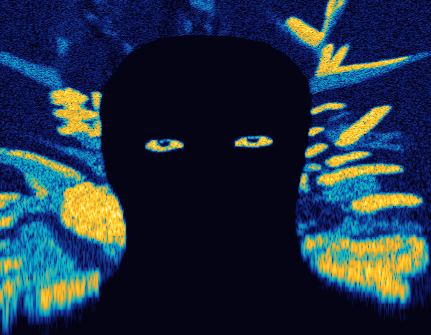
Some of the most famous "hidden pictures" in music history were never hidden in the lyrics, the artwork, or a backmasked message. They were hidden in the shape of the sound itself, invisible on a normal waveform and only visible if you run the track through a spectrogram, a graph that shows which pitches are playing at every instant. Look at the right song the right way, and a face looks back at you.
This isn't a rare accident. It's a real, decades-old technique with a specific history, a handful of famous examples, and a growing community of producers who use it as a kind of signature, or "tag," buried inside their own tracks.
What a Spectrogram Actually Shows You
A spectrogram is just a picture of a sound. Time runs left to right, pitch runs bottom to top, and how bright a point is shows how loud that pitch is at that exact moment. A kick drum shows up as a bright vertical smear low on the graph. A cymbal shows up as a bright, noisy patch stretched across the top. A held vocal note shows up as a thin, steady horizontal line.
Because a spectrogram is just a grid of brightness values, the idea of hiding a picture inside one isn't a metaphor. You can take an actual photo, treat every pixel as a "how loud is this pitch, right now" instruction, and build a sound wave that plays those instructions back. Play the resulting file normally and it usually sounds like harsh noise or a burst of static. Look at it on a spectrogram, and the photo reappears.
Where the Spectrogram Came From
The tool that makes any of this possible wasn't built for music at all. It was built to study speech.
In the early 1940s, researchers at Bell Telephone Laboratories, led by Ralph K. Potter, built a machine that could turn a sound recording into a picture, plotting frequency against time on a strip of paper. Bell Labs published the technique in the Journal of the Acoustical Society of America in 1946, and the team followed it with a book the next year called Visible Speech. The original goal was almost entirely practical: help researchers, and eventually deaf students, "see" speech patterns that the ear alone couldn't easily analyze, and support wartime research into voice communication.
For decades afterward, the spectrogram stayed a scientific and linguistic tool, useful for studying birdsong, diagnosing speech disorders, and analyzing recordings. It took the arrival of consumer computers, and specifically software that could work in reverse, turning a picture into sound instead of a sound into a picture, before anyone thought to use it as a place to hide art.
From Lab Instrument to Secret Art Tool
That reversal became practical in the late 1990s. In 1997, a company called U&I Software released MetaSynth, a program that let musicians paint directly onto a time-and-frequency grid the same way you'd paint in an image editor, then hear the result as sound. Brightness controlled volume, color controlled stereo position, and the vertical axis was pitch. It was a strange, painterly way to make music, and it found fans among sound designers (it was used to help design bullet-speed effects for The Matrix) and experimental musicians alike. Free tools like Coagula followed soon after, doing something similar for anyone willing to experiment.
Once musicians had software that could turn an image into sound on purpose, hiding a picture inside a track stopped being a theoretical curiosity and became a genuine, repeatable trick. A handful of artists picked it up early, and their tracks are still the examples everyone points to today.
The Famous Examples
Aphex Twin's Face
The best-known case by a wide margin belongs to Aphex Twin. The B-side to his 1999 single "Windowlicker," a track usually referred to as "Equation" or "Formula," was built in MetaSynth around a photo of the artist's own face. The image sat unnoticed for two years until 2001, when an online user going by chāosMachine ran the track through a spectrogram plugin and found it staring back, a grinning, slightly warped face that fans nicknamed the "demon face." There's a real technical detail that trips people up when they try to find it themselves: on a linear frequency scale the image looks like little more than a pair of eyes, but switch the analyzer to a logarithmic scale (the same log-vs-linear choice you'll see in most spectrum analyzers, and the one our own tool defaults to) and the full face resolves clearly.
Venetian Snares' Cats
Breakcore producer Venetian Snares (Aaron Funk) closed out his 2005 album Songs About My Cats with a track called "Look." Play it normally and it's dense, chaotic breakbeat music. Run it through a spectrogram and it reveals exactly what the album title promises: pictures of his cats, deliberately edited into the track's spectral content rather than discovered by accident.
Nine Inch Nails and the Year Zero ARG
Nine Inch Nails used the technique for marketing, not just an easter egg. In the lead-up to 2007's Year Zero, an elaborate alternate reality game sent fans hunting for physical USB drives left at concerts. One found in a Lisbon bathroom in February 2007 contained an early copy of "My Violent Heart," which the band later confirmed on the finished album ends in a burst of harsh static. Fans analyzed that static with a spectrogram and found "The Presence," the same god-like hand that appears in the album's official artwork, staring back out of the noise. A drive found days later in Barcelona pushed the game further, hiding a working phone number inside its own static.
Fez and the Puzzle That's Never Been Solved
The technique made the jump from music into games with 2012's Fez. Composer Rich Vreeland, known as Disasterpeace, hid images throughout the soundtrack at the request of the game's creator, Phil Fish: the track "Beacon" hides Neil Armstrong's first footprint on the Moon, "Beyond" hides a character from Lost, and "Progress" hides the game's own recurring cube symbol. Players found the pictures within days of release, folding them into the game's already famously cryptic puzzles. Disasterpeace has since said he genuinely doesn't know how the full puzzle behind them is meant to be solved.
Why Producers Still Do This
Long before spectrogram art existed, producers already had a tradition of stamping tracks with a personal signature: a spoken "tag" dropped over a beat, the way a mixtape DJ might drop their own name over a hot verse, or a graffiti artist signs a wall. A hidden spectrogram image is the same instinct pointed at a different sense. It's a mark that says "I made this," but instead of being audible, it's something a listener has to go looking for.
That's exactly why the trick has stuck around for over two decades instead of fading as a one-off gimmick. It rewards curiosity rather than demanding attention, which is a different kind of engagement than a hook or a drop. Nobody needs to see the image for the track to work as a piece of music, but the people who do go looking get let in on something the casual listener missed entirely, and that's a satisfying trade for both sides.
Making Your Own
For most of this history, doing any of this meant learning specialist software like MetaSynth, or hand-editing raw spectral data. That's no longer true. We built the Spectrogram Tag Maker as a free, browser-based way to do the same thing Aphex Twin did in 1999, minus the learning curve: upload a photo, watch a live preview of what it'll look like on a real analyzer, adjust things like frequency range, resolution, and sample rate, and export a WAV file when it's ready. Nothing to install, nothing to buy.
If you've read this far, you already understand more about how these hidden pictures work than most of the people who've stumbled across one without knowing why it was there. Give it a try and hide your own.